Furnished Offices For Rent Makkah: Practical Answers For Enterprises
A ready workplace can shorten the path from lease signing to daily operations. This guide addresses common questions and misconceptions before an established company chooses its Makkah office.
What Does A Turnkey Office Actually Include?
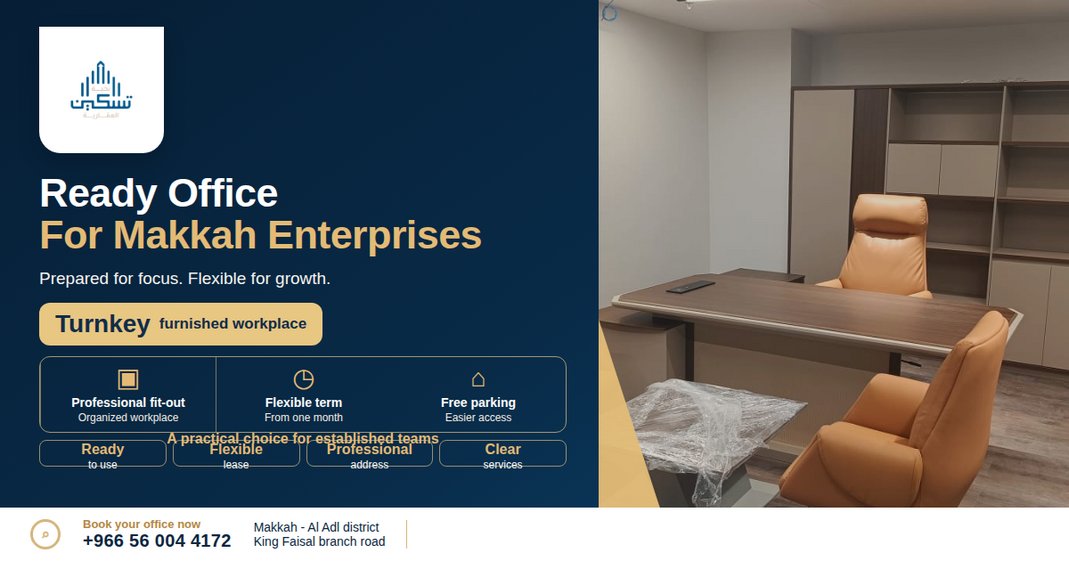
The phrase furnished offices for rent Makkah usually describes a workplace prepared for occupation. It may include finished interiors, essential furniture, organized services, and a professional setting. However, the exact scope depends on the building, the agreement, and the tenant’s operating model.
That distinction matters for enterprises. A senior team may need private rooms, meeting space, reception capacity, secure access, and room for visiting clients. Therefore, “ready” should be tested against the company’s workflow rather than accepted as a generic label.
A turnkey offer can still be a sensible way to reduce coordination. The company avoids managing every contractor, furniture order, and installation step. However, it should ask for a written schedule of included items, responsibilities, and handover conditions.
Furnished Is Not The Same As Fully Operational
Furniture improves immediate usability, but it does not answer every operational question. An enterprise should review lighting, internet arrangements, meeting-room use, cleaning, maintenance, visitor handling, and access hours. These details shape the real experience more than a staged photograph.
It is also useful to separate fixed elements from adaptable ones. Desks, chairs, partitions, and storage may support the current team, yet the business could require a different arrangement later. Ask which changes are permitted and whether approval is required.
Companies comparing turnkey office solutions Saudi Arabia should assess service clarity as carefully as interior quality. A practical solution explains what the tenant receives, what the property team manages, and how requests are handled after move-in.
Five Questions Enterprises Should Ask Before Leasing
First, ask how flexible the lease term can be. Contracts starting from one month can help a company test a branch, manage a transition, or house a project team without assuming a long commitment too early.
Then, clarify the financial and operational boundaries in the agreement. Ask about included services, maintenance response, changes to the layout, access arrangements, and the process for renewal or exit. Clear answers reduce surprises for finance and operations teams.
Next, examine the office’s capacity for change. An established company may add staff, host larger meetings, or separate departments during the lease. A location with varied office sizes can offer more practical choices than a single fixed format.
Finally, visit the property at a realistic working time. A site visit reveals arrival patterns, visitor routes, noise, lighting, parking access, and the distance between the office and shared facilities. It also helps decision-makers compare the promise with the actual environment.
Does Location Matter More Than A Large Floorplate?
For many enterprises, a credible address and reliable access matter more than unused space. Makkah businesses often meet government representatives, suppliers, clients, and partners. A clear location near relevant offices can make those meetings easier to plan.
Access also affects employees. Consider how staff reach the property, where visitors park, and whether the entrance is easy to explain. Free parking can support daily attendance and client visits, although the company should confirm the applicable usage arrangements.
When reviewing offices for rent in Makkah or offices for rent in Al Adl Makkah, consider the combined value of location, readiness, and support. A large office in an inconvenient setting may create more friction than a well-prepared office that fits the team and the route network.
Makkah also serves business activity connected with government, hospitality, services, pilgrimage-related commerce, and local trade. Consequently, an enterprise office can play a practical role in coordinating a wide range of relationships. The address should support that role without overstating what a location can achieve.
How Should An Enterprise Evaluate Furnishings?
Start with the work, not the style. A legal, consulting, technology, or service company may need different proportions of private offices, collaborative tables, meeting rooms, and quiet areas.
Review the furniture’s condition, ergonomics, storage, and flexibility. Ask whether the arrangement supports confidentiality when needed. Also check whether the reception area presents a calm and professional first impression for customers and partners.
Good furnishing should make routines easier. It should allow staff to move comfortably, hold focused meetings, welcome visitors, and maintain a consistent work rhythm. Therefore, a polished look is useful only when it serves the people using the office.
The same principle applies to office leasing Makkah more broadly. Leasing decisions should connect space, services, contract terms, and business objectives. The company should be able to explain why the office fits its current stage and its likely next step.
Are Shorter Contracts Only For Small Businesses?
No. Larger organizations may also need flexibility when entering a new market, relocating a department, opening a temporary project office, or coordinating a wider property plan.
A shorter initial term can create a review point. The enterprise can observe employee use, visitor patterns, meeting demand, and service performance before choosing a longer arrangement. However, flexibility should still be documented carefully in the lease.
Review notice periods, renewal language, permitted changes, handover expectations, and access rights. In addition, ask how the property team communicates maintenance updates and operational notices. These provisions matter when several departments depend on one location.
Common Misconceptions About Furnished Offices
“A furnished office removes every setup task.”
It can reduce setup work, but a company may still need branding, equipment, connectivity, access permissions, internal policies, and document storage. A realistic move-in plan separates property readiness from business readiness.
“A premium appearance proves that the office is efficient.”
Appearance and performance are different measures. The company should test circulation, acoustics, privacy, comfort, service access, and meeting capacity. As a result, the inspection should involve more than the person responsible for visual presentation.
“The biggest office is the safest choice.”
Unused space can add complexity without adding value. A right-sized office may improve team coordination and reduce the effort required to maintain an underused area. The better choice is the office that supports the planned work.
“A flexible contract means that the details do not matter.”
Flexibility makes details more important, not less. Confirm the term, renewal path, changes, services, access, and responsibilities. Then have the relevant company stakeholders review the wording before signing.
Why Established Companies Still Consider Ready Offices
Enterprises often have procurement standards, brand requirements, and approval processes. A prepared office can make those processes easier to coordinate because the company evaluates a functioning setting rather than managing every part of a fit-out.
It can also support a measured expansion strategy. The company may need a Makkah presence before it knows the long-term size of the team. A flexible, professionally managed office provides a practical test without pretending that every future need is already known.
Moreover, a ready setting can help a regional team maintain consistent service. Employees can focus on clients, operations, and internal coordination instead of spending months supervising basic workplace preparation. The benefit is strongest when the lease terms and services are transparent.
Taskin Aqaria And Pride & Joy Business Tower
Taskin Aqaria develops, manages, operates, and leases real estate projects in Saudi Arabia. Its work also includes property management, facility management, and asset management. That wider perspective is relevant when an enterprise evaluates the office and the support around it.
Pride & Joy Business Tower is a modern administrative tower in Makkah’s Al Adl district, at Jabal Al Nour on King Faisal branch road. Its position near government offices can suit businesses that need a clear professional address for regular meetings and administrative work.
The tower offers offices in varied sizes, flexible contracts starting from one month, and free parking. Some views include the Clock Tower and Ghar Hira. These features can support a company’s practical assessment, but the final choice should still reflect team size, operating needs, and contract review.
Enterprises can discuss their requirements with Taskin Aqaria before selecting a space. The discussion can cover expected occupancy, client visits, meeting patterns, duration, parking, and the preferred level of furnishing. Clear requirements lead to a more useful comparison.
For a company seeking a structured Makkah base, Pride & Joy Business Tower offers a relevant option to examine. Its value lies in how the location, office choice, flexibility, parking, and property management align with the business plan.
A Practical Enterprise Decision Framework
Begin with an operating brief. Note the number of users, privacy needs, meeting frequency, visitor profile, equipment needs, expected term, and potential growth. This brief prevents the company from choosing on appearance alone.
Next, create a site-visit checklist. Review arrival, parking, reception, office flow, shared facilities, natural light, noise, maintenance routes, and security procedures. Then record what is included and what the company must arrange.
After the visit, compare the lease with the operating brief. Finance should review commitments, procurement should review scope, and operations should review practical delivery. Human resources can also consider staff access and workplace comfort.
For more guidance on real estate decisions and workplace planning, visit the Taskin Aqaria Blog. Enterprises can also connect workplace planning with the broader economic direction described by Saudi Vision 2030.
Conclusion: Readiness Is A Business Decision
A furnished office is valuable when it reduces unnecessary setup without hiding important details. The best evaluation covers location, access, parking, furnishings, services, flexibility, and the company’s actual operating model.
Common misconceptions usually begin with a simple assumption: that a ready office is automatically the right office. In practice, a professional decision comes from asking precise questions, visiting the site, and reviewing the agreement with the right stakeholders.
If your enterprise needs a Makkah base, define the work first and then assess the space. A transparent conversation can help your team choose a workplace that is ready, practical, and aligned with the next stage of operations.
Book your office now at Pride & Joy Business Tower in Makkah — contact Taskin Aqaria through the official website.