Coworking vs Private Office: Location Value and Return
For an investor or property owner, the workspace decision is not a choice between two furnishing styles. It is an operating decision that influences who can use the building, how easily they can adopt the space, and whether the address can remain relevant as their requirements change. A coworking setting and a private office can both create value, but only when the location, service model, and tenant profile support one another.
The Asset Lens: What Is the Location Enabling?
A useful coworking vs private office comparison begins with the asset rather than the desk. Does the location help a growing business meet clients without friction? Does it make the address simple to find? Can the building offer a professional arrival experience and practical access to parking, lifts, and nearby services? These questions determine whether flexibility or privacy will be most valuable to the end user.
Location is not simply a line on a map. It shapes the daily cost of doing business: the reliability of client visits, the convenience of staff arrival, and the confidence a company gets from presenting a clear address. When these elements are in place, a shared environment can work as a low-commitment base and a private suite can work as a long-term professional home. Without them, both formats must compensate for a weak user experience.
A Market View of Makkah Workspace Demand
Businesses looking for shared office space Mecca are not a single audience. A consultant may need a credible place to work between appointments; a newly formed team may need a formal business presence; an established service company may need a confidential meeting setting. For investors, the strength of a building lies in its ability to serve several of these needs without creating confusion about the offer.
In Makkah, an office address that is clearly connected to principal routes and business activity has a practical advantage. It can shorten the gap between an intended meeting and an actual arrival. This is meaningful for a property owner because dependable access supports repeat use. It also makes it easier for a prospective tenant to see the building as part of their operating routine instead of a place they have to explain to every visitor.
Where Coworking Creates Operational Value
A coworking space for freelancers can meet an important early-stage need: a professional work setting without the burden of fitting out and maintaining a separate suite. It can also serve founders who need a practical base while they test a market, build a team, or establish a schedule of in-person meetings. This flexibility can broaden the building’s tenant funnel when it is paired with well-managed shared facilities.
From the owner’s perspective, however, flexibility only becomes durable value when operations are clear. Booking rules, shared-area standards, reception arrangements, service expectations, and a calm working environment all matter. The most credible benefits of coworking spaces are not vague promises of community; they are visible conveniences that allow a user to work, host, and leave with confidence that the space will function consistently the next time.
That is why location still matters within a flexible product. A shared seat in a building that is easy to reach and comfortable to navigate can reduce practical barriers for users who have limited time to manage office logistics. For the asset, it creates a stronger basis for ongoing interest than novelty alone.
Why a Private Office Still Protects Demand
Private offices address a different operating requirement. They suit businesses that need controlled conversations, dedicated files, a stable team setting, or a distinctive environment for client meetings. Privacy is not an aesthetic preference in these situations; it is part of the service a company delivers. A private suite in the right location can therefore support both business continuity and the professional identity of the tenant.
For a property owner, the two formats do not have to compete. A building may use shared workspaces to welcome emerging users and private offices to accommodate firms that need greater permanence. When the property enables tenants to move from a flexible arrangement to a dedicated office as their needs develop, it can retain relationships that might otherwise leave for a different address.
Return on Investment Is More Than a Quoted Rate
Searches for coworking membership prices Makkah often start with a price question, but a useful investment appraisal cannot end there. The commercial value of a workspace depends on what is included, how efficiently the user can begin, how the building operates, and whether the location reduces other costs in time and coordination. A lower initial figure does not necessarily represent better value if the user must separately solve access, meeting, reception, or fit-out needs.
For owners, a durable return is better assessed through occupancy quality, tenant retention, the clarity of the offer, and the ability to match space with real user demand. It is also affected by management discipline: predictable service delivery and transparent expectations encourage tenants to see the property as a reliable business tool rather than a temporary compromise.
Location Due Diligence for Owners and Investors
A site visit should test the operating reality of the building. Follow the route a client would take, observe entry and circulation, check whether parking and access feel intuitive, and consider what surrounds the property. The goal is not to seek a generic “premium” label; it is to determine how the address supports the actual workflow of a prospective tenant.
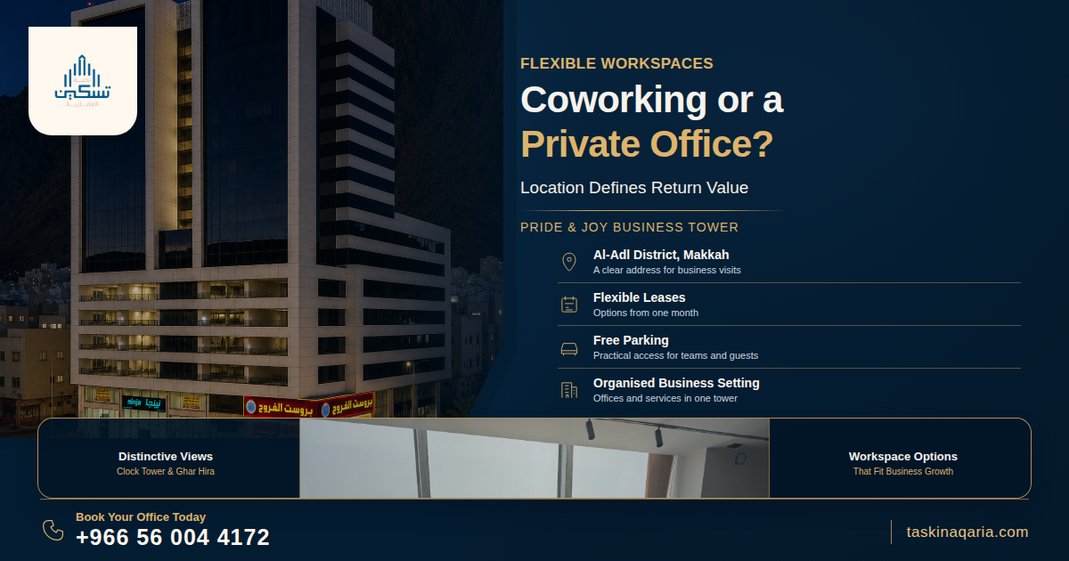
Pride & Joy Business Tower is located in Al-Adl district, Makkah, on King Faisal branch road in Jabal Al-Nour. Its setting near government offices offers a practical context for organisations that need a recognisable address for meetings and visits. The tower also offers free parking, varied office sizes, and flexible lease contracts starting from one month, allowing occupiers to assess a workspace arrangement against their current operating needs rather than an assumed long-term model.
Designing a Portfolio of Workspace Choices
The question for a property owner is rarely whether every unit should be shared or private. A more resilient approach considers the mix of users the building can support. Independent professionals, small teams, client-facing service firms, and businesses that require confidentiality may all value the same location for different reasons. A clear portfolio of workspace options lets the property respond to that variation while keeping the building’s positioning coherent.
This is where asset management and tenant experience meet. Taskin Aqaria approaches real estate development, management, and operation as connected responsibilities. A well-run office asset communicates the space available, the service included, and the practical conditions of use without overstating what it can deliver. That transparency helps owners judge demand and helps users choose a setting that fits their work.
A Practical Decision Framework
Choose a Shared Workspace When
- The user values a ready professional setting and adaptable use.
- Work patterns are developing and a dedicated fit-out would be premature.
- The location makes meetings, arrival, and day-to-day access straightforward.
- Shared services are clearly managed and aligned with the tenant’s routine.
Choose a Private Office When
- Confidentiality, dedicated storage, or consistent team collaboration is central to the business.
- The company needs an address and environment that reflects its own client experience.
- The workspace is expected to operate as a stable part of a wider business process.
- The location strengthens the office rather than forcing clients and staff to make avoidable compromises.
For more practical perspectives on office selection and property operations, explore the Taskin Aqaria Blog. The next step should always be to connect these criteria to a real visit, a clear operating proposal, and the needs of the intended occupier.
Putting the Decision in Context
The better format is the one that turns the location into a usable advantage. Coworking can improve adoption by making a professional address easier to access. A private office can protect focus and client confidence by giving a business dedicated control. Both depend on whether the building’s operations and setting make daily work more straightforward.
For an investor or owner assessing Makkah business space, Pride & Joy Business Tower provides a location-led reference point: an administrative tower with business office options, free parking, and views towards the Clock Tower and Ghar Hira. Through its property management, facility management, asset management, and leasing expertise, Taskin Aqaria focuses on the practical relationship between the property, its operations, and the organisations it serves.