Office Leasing Makkah: Practical Enterprise Decisions
For an established company, an office lease is rarely just a property transaction. It sets the stage for staff routines, client meetings, vendor visits, document handling, and the reliability of the daily operating rhythm. A disciplined office leasing Makkah process therefore begins with operational evidence, not a shortlist of attractive photographs.
The most useful question is not “Which office looks best?” but “Which office will help this organisation work with the fewest avoidable compromises?” That shift makes it easier to compare alternatives objectively and helps senior stakeholders see why a location, a lease term, or a building service matters to the business.
Build a Decision Memo Before Booking Viewings
Enterprises benefit from a short leasing memo that is agreed internally before viewings begin. It should name the departments that will use the space, the kind of visitor traffic expected, the need for formal meeting rooms, the degree of confidentiality required, and the technical conditions that cannot be deferred. It is also useful to distinguish requirements from preferences. A welcoming reception may be important; secure access or a dependable client route may be essential.
This memo becomes the shared yardstick for operations, finance, HR, administration, and leadership. Without it, every visitor may judge an office by a different standard, and the final recommendation can become a collection of unrelated impressions. With it, the team can compare commercial office space Mecca against the way the organisation actually works.
Keep the document practical. It does not need speculative growth figures or a complex scoring model. A concise statement of intended use, visitor patterns, required services, and lease constraints is enough to frame a more reliable conversation with a property representative.
Walk the Customer and Employee Journey
A site visit should follow the same journey a visitor or employee will take on an ordinary workday. Start from the approach road, identify the entrance, check how a guest is directed to the building, observe the route to reception, and note how the lift and corridor experience supports the appointment. This is more revealing than stepping straight into a unit after being guided through the building.
For companies with frequent meetings, parking and arrival clarity deserve particular attention. Ask how guests are expected to use available parking, how the building handles access at busy times, and whether the journey remains straightforward for people who do not know the area. When assessing offices for rent in Makkah, a well-located unit can lose value if the visitor experience is difficult to manage.
Repeat the visit, where possible, at a time that resembles the company’s normal schedule. A quiet mid-day inspection may not show traffic conditions, lift use, or the way common areas feel when the building is active. The goal is not to find a flawless building; it is to identify conditions that the business can operate with confidently.
Use the Lease as an Operating Document
One common mistake is to treat the unit selection and the lease review as separate stages. In practice, the lease tells the business how the office can be used. Duration, renewal procedure, access arrangements, maintenance responsibility, permitted fit-out work, and the treatment of shared facilities all influence the experience after signing.
Ask the operational owner to read the same documents as the legal and finance teams. Legal review protects the organisation’s contractual position, while operational review tests whether the provisions support normal work. For example, a clause on alterations may be routine to a reviewer but decisive to a business that needs a meeting room, access controls, or a revised layout before staff move in.
Organisations with a temporary project, regional programme, or changing team configuration may also want to discuss flexibility early. Lease options at Pride & Joy Business Tower can begin from one month, but the right term remains the one that matches the company’s genuine operating plan. Flexibility is useful when it solves a defined need, not when it replaces due diligence.
Common Leasing Mistakes and Better Responses
Choosing by appearance alone
A polished interior can make a strong first impression, yet it does not automatically confirm that the space supports a particular team. Test the practical fit: where will visitors wait, how will private conversations be held, what work needs fixed desks, and how will equipment or records be accommodated? A layout should be assessed for work patterns rather than visual impact alone.
Leaving building services undefined
Security, lift access, cleaning arrangements, building management, and maintenance response do not have identical scope in every property. Request clear explanations of what the building manages and how a tenant reports an issue. An assumption made at the viewing stage should not become a later disagreement about responsibility.
Ignoring the address in relation to the organisation’s network
Location should be considered in the context of employees, clients, public-sector visits, and supplier access. Companies comparing offices for rent in Al Adl Makkah may find that the same district means different things to different functions. Map the journeys that matter to the business rather than relying on a broad description of convenience.
Accepting unclear handover expectations
Before commitment, record the expected condition of the unit, the tasks that remain with the owner or manager, and the work that belongs to the tenant. A clear handover discussion helps the move-in team sequence technology, furnishing, signage, and communications without working from assumptions.
Making the decision through a single department
Finance may focus on the commitment, operations on the flow of work, and HR on employee accessibility. None of these lenses should decide alone. A compact cross-functional review is usually more valuable than a large committee formed late in the process; it surfaces material conflicts while there is still time to compare options.
Test the Unit as a Working Environment
During an inspection, allow time to observe the unit beyond its main room. Notice the daylight and glare at workstations, sound transfer from adjacent spaces, likely routes for cables and equipment, and the relationship between open areas and private conversations. These are not cosmetic details. They shape whether the office can support focused work as well as client-facing activity.
Building context matters too. A business tower Makkah should be considered as a whole environment: arrival areas, lifts, security procedures, parking, common spaces, and the responsiveness of the facilities operation. The unit may be the direct leased asset, but the wider building experience affects employees and visitors every day.
At Taskin Aqaria, an enterprise can discuss its office requirements with a focus on operational fit, including the relevant location and building services. That conversation is more productive when the company arrives with a clear brief, asks the same questions of each alternative, and treats the inspection as evidence gathering rather than a sales presentation.
Turn the Comparison Into a Defensible Recommendation
After the visits, consolidate notes into a decision record. Include each site’s access route, fit with the operating model, building services, lease points requiring clarification, and any action needed before handover. The purpose is not to create artificial precision. It is to ensure that the chosen office has a documented reason for meeting the organisation’s priorities better than the alternatives.
Use the same questions for every prospective property. Consistent questions about maintenance, access, parking, fit-out, and lease procedure make it easier to identify genuine differences rather than differences in how a proposal has been presented. Items with incomplete answers should remain open actions, not silently become positive assumptions.
For additional practical perspectives on office premises and property operations, visit the Taskin Aqaria Blog. A well-run search process keeps the discussion grounded: requirements first, site evidence second, contract review alongside the business case, and a clear plan for the move.
From Selected Space to a Ready Office
The lease decision is followed by a transition project. Assign owners for fit-out coordination, IT readiness, workplace safety, visitor communications, and the internal announcement of the new address. This prevents a strong property decision from becoming a difficult move because small dependencies were discovered too late.
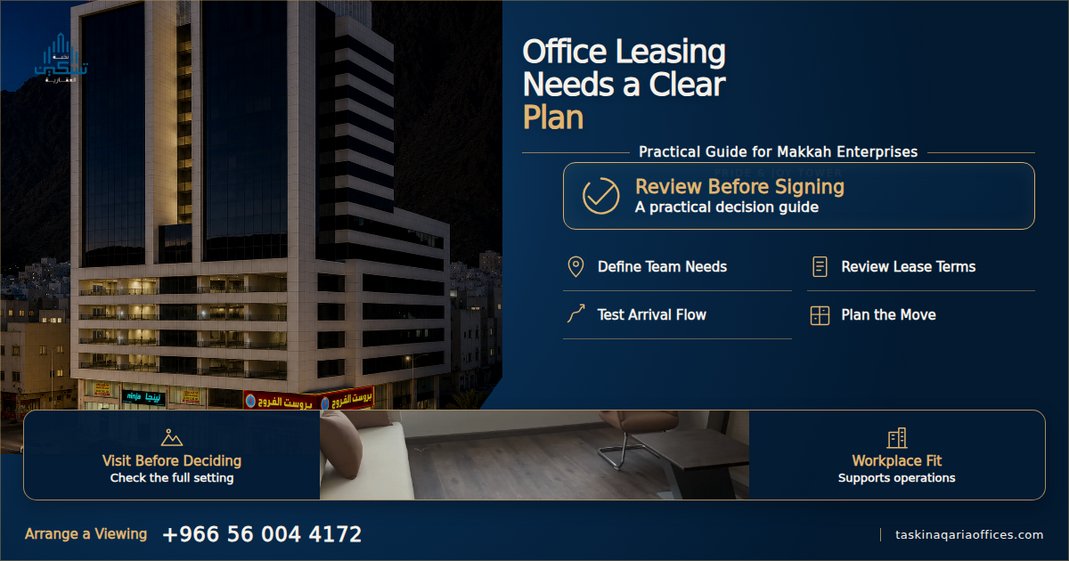
Pride & Joy Business Tower is a modern administrative tower in Makkah’s Al Adl district on King Faisal branch road, with offices in varied sizes, free parking, and views towards the Clock Tower and Ghar Hira. Those features should be considered alongside each enterprise’s own workflows, visitors, and lease priorities. There is no substitute for a site visit and a complete review of terms.
Practical office leasing is ultimately an exercise in clarity. When a company defines the work the office must support, checks the journey into the building, investigates the service model, and reviews the lease before committing, it gives the new premises a better chance to support steady and professional operations.