Benefits of Coworking Spaces for Makkah Companies
Established companies need workplaces that support control, flexibility, and professional credibility. This guide connects the benefits of coworking spaces with commercial real estate trends in Makkah and Saudi Arabia.
Why the benefits of coworking spaces matter to enterprises
Large companies do not choose offices by floor area alone. They assess operating speed, employee experience, visitor access, privacy, and future expansion. As a result, coworking spaces can serve as a practical layer within a broader workplace strategy.
An enterprise may need a project office in Makkah, a temporary base for a field team, or a meeting address for visiting clients. A shared workplace can answer that need without requiring a company to build a full branch before demand is proven.
This does not make coworking suitable for every department. Sensitive work may require dedicated rooms. A customer-facing team may need controlled reception. Therefore, the right decision starts with the operating model, not with a fashionable workplace label.
Flexible commitments reflect a changing commercial property market
Saudi commercial real estate is becoming more responsive to changing business requirements. Companies want assets that can support staged growth and temporary programs. That is one reason coworking spaces in Makkah belong in the conversation about efficient office use.
Contract flexibility can help an enterprise align space with a project calendar. A contract that starts from one month may suit a market test, a new service team, or an assignment with an uncertain duration. It also gives management time to validate headcount and working patterns before making a longer commitment.
Flexibility still requires careful review. The company should ask about access hours, meeting rooms, guest handling, maintenance, internet arrangements, and notice periods. It should also confirm which services are included and which require a separate arrangement.
A professional address can support enterprise operations
Location shapes more than the first impression. It affects daily commuting, client meetings, supplier visits, and contact with public institutions. For this reason, shared offices in Makkah may be useful when they provide a clear address inside a recognizable administrative building.
Makkah has a distinctive business context. Activity connected to residents, visitors, government services, and pilgrim-season commerce creates varied operating needs. A company may therefore value a location that is accessible, professional, and close to relevant services.
Parking also matters. So do the entrance, reception flow, building management, and availability of meeting spaces. These details determine whether a workplace functions well after the initial viewing.
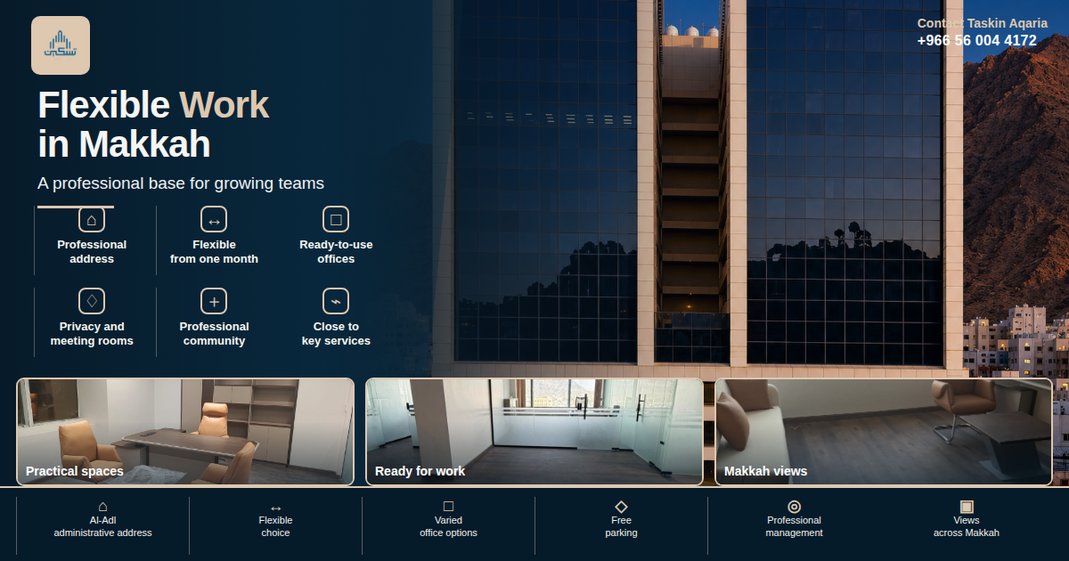
Pride & Joy Business Tower is located in Al-Adl district, near Jabal Al-Nour and King Faisal branch road. Its setting offers companies an administrative address in Makkah, with practical proximity to government offices and local business activity.
Ready-to-use space reduces the time required to launch
An enterprise may need a functioning workplace before a conventional fit-out can be completed. A ready office can reduce coordination across furniture, reception, meeting facilities, and basic building services. However, the term ready-to-use should always be tested during a site visit.
flexible workspaces can also reduce the administrative effort attached to opening a new location. Instead of arranging every service separately, the company works with one managed environment. Consequently, the project team can focus on delivery while the operator manages day-to-day facilities.
This model can support sales teams, consulting groups, program offices, training units, and temporary project teams. It may also help an established company test a Makkah presence before investing in a larger standalone branch.
Privacy and collaboration can coexist
Some enterprises associate shared workplaces with noise or weak confidentiality. In practice, the outcome depends on layout and operating rules. A well-planned site separates quiet rooms, meeting areas, circulation, and informal collaboration zones.
Different departments require different levels of control. An executive team may need enclosed rooms. A business development group may prefer an open project table. A visiting adviser may need a quiet desk for one day. The company should ask the operator how these use cases are handled.
Shared environments can also create professional contact between occupants. That contact may lead to useful knowledge, a referral, or a local introduction. It should be treated as an opportunity, not as a guaranteed commercial result.
For established companies, the key is to define confidential work before selecting a desk plan. Information security, document handling, visitor access, and meeting privacy should be part of the workplace brief.
Cost efficiency begins with a realistic workplace brief
The financial case for a coworking arrangement cannot be judged by rent alone. Management should compare the base commitment with furniture, fit-out, cleaning, reception, meeting facilities, maintenance, and relocation effort.
Some enterprises search for offices for rent in Makkah because they need a more independent setup. Others may prefer a managed shared environment for a small regional team. Both approaches can be reasonable when they are matched to the work.
A clear brief should distinguish permanent requirements from temporary ones. If headcount may change, flexibility could be more valuable than a final layout. If the team receives many visitors, controlled reception and meeting capacity may matter more than an open plan.
Companies should also look beyond the first month. A useful comparison includes the cost of changing space, ending a contract, adding rooms, and supporting staff. Transparency at this stage reduces surprises later.
How Makkah fits wider Saudi commercial real estate trends
Makkah’s commercial property market reflects a mix of local services, government activity, visitor-related demand, and professional business growth. At the national level, companies are also adapting to a more diversified economy and more active service sectors.
These changes increase the value of adaptable workplaces. A business may need a small presence today and a larger operating base later. It may also need a temporary location during a project cycle. The goals of Saudi Vision 2030 provide a wider context for business development, although each company still needs a practical property decision.
For enterprises, the trend is not simply toward smaller offices. It is toward better alignment between space and work. Some departments will need private offices. Others may benefit from meeting rooms and shared facilities. A portfolio can combine both approaches.
Seasonal activity can add another layer. A company serving visitors or local businesses may experience changing demand during the year. A flexible site can be part of its planning, provided that access, confidentiality, and service standards are suitable.
Taskin Aqaria and Pride & Joy Business Tower as a practical option
Taskin Aqaria develops, manages, operates, and leases real estate solutions for administrative, commercial, and industrial uses. Its approach connects the physical workplace with the practical requirements of the business.
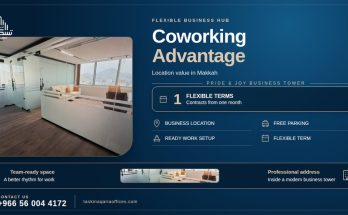
Pride & Joy Business Tower offers offices in different sizes and flexible lease contracts starting from one month. The tower also provides free parking, views toward the Clock Tower and Ghar Hira, and proximity to government offices.
These features can help a company build a focused shortlist. They do not replace a site inspection. An enterprise should still assess room configuration, visitor flow, privacy, connectivity, meeting needs, and the fit between the building and its daily operations.
Management teams can discuss the available options with Taskin Aqaria according to their business requirements. The best choice depends on team size, attendance patterns, confidentiality, and expected change.
For further practical guidance, the Taskin Aqaria Blog covers workplace selection, office evaluation, and commercial property considerations for business owners.
A decision checklist for established companies
Begin with access and location. Check travel routes, parking, reception, signage, and proximity to the people and institutions the team meets. Then review contract flexibility, notice periods, renewal terms, and the process for changing the required space.
Next, inspect the working environment. Ask about enclosed rooms, meeting capacity, quiet areas, visitor policy, connectivity, cleaning, maintenance, and emergency procedures. If the company handles sensitive information, confirm how privacy is protected in shared areas.
It is also useful to test the workplace during a normal operating period. A quiet viewing can hide circulation issues or meeting pressure. Where possible, evaluate the arrival experience, sound levels, and the time needed to move between work areas.
Finally, request a written scope of services. Compare the offer with the workplace brief rather than with a general promotional image. A sound decision balances address quality, flexibility, privacy, service, and long-term fit.
Conclusion: choose space that follows the work
The benefits of coworking spaces extend beyond a furnished desk. They include faster setup, adaptable commitments, professional access, and the ability to test a location before scaling. In Makkah, those qualities can support established companies managing projects, regional teams, and changing service demand.
No single workplace fits every department. The responsible process is to define the need, visit the site, review the operating terms, and compare the full cost of use. When the workplace reflects how the company actually works, it becomes an operating advantage rather than just an address.
Contact Taskin Aqaria to explore a professional workspace in Makkah that fits your company’s operating needs.