Coworking Spaces in Makkah: A Practical Guide
Choosing Coworking Spaces in Makkah should make daily operations easier, not simply look polished. Use this practical checklist before committing to a space.
Why Coworking Spaces in Makkah Need Careful Evaluation
Makkah has a business rhythm shaped by government activity, visitor services, and seasonal commerce. That context makes access, professional presentation, and operational reliability especially relevant. A space that works for a freelancer may not work for a client-facing consulting team.
Coworking Spaces in Makkah can help startups, independent professionals, and remote teams avoid a heavy long-term commitment. However, flexibility is useful only when the service details are clear. Ask what is included, how visitors are handled, and how private conversations are protected.
A professional address can support a first meeting, but it should also support the work behind that meeting. Therefore, assess the route, the entry experience, the working atmosphere, and the support process. Do not let attractive photography replace a practical inspection.
Tip One: Choosing Coworking Spaces in Makkah by Location
Location is more than a neighborhood name. It includes the time your team spends travelling, the route clients take, and your proximity to recurring appointments. Businesses serving Makkah may benefit from being close to government offices and major roads.
On the other hand, a remote location can create hidden friction even when the rent appears attractive. Late arrivals, difficult meetings, and uncertain visitor access all affect professional routines. List the places you visit most often, then compare each workspace against that list.
A coworking space Makkah search is more useful when it reflects your real network. When reviewing a shared office Makkah option, check entrances, signage, parking, and the path from the street to your desk. These details shape the client experience before the meeting begins.
Tip Two: Define What Flexible Terms Actually Mean
Flexibility may mean a contract starting from one month, a private room within a shared setting, or the ability to adjust seats as a team changes. It does not mean the same thing in every building. Ask for the meaning in writing.
Review the notice period, start date, renewal process, and rules for adding or removing users. Then identify the services included, such as internet, cleaning, maintenance, meeting rooms, and reception support. Clear terms reduce surprises and make planning easier.
For an early-stage business, offices for rent in Makkah with flexible contracts may protect cash flow and preserve room for change. Still, a short commitment is not a substitute for a clear agreement. Read the responsibilities on both sides before signing.
Tip Three: Choose Capacity for How the Team Works
The largest available room is rarely the most efficient choice. A compact office may suit a small team that works quietly, while a client-facing company may need a reception point and a meeting room. Capacity should follow work patterns rather than an abstract desire for more space.
Look at desk spacing, movement paths, call areas, natural light, and storage. If most work happens remotely, you may need fewer permanent seats and better rooms for focused calls. If the team collaborates in person, make sure shared tables do not block circulation.
The same principle applies to flexible office space Makkah. A useful office is not defined by size alone. It should support concentration, present the business professionally, and leave a sensible path for growth.
Common Mistakes That Weaken the Decision
Mistake One: Choosing from a Single Photograph
A photograph may hide sound levels, access routes, glare, or the condition of shared equipment. Visit the site when possible. Test the atmosphere during a normal working period, and ask how interruptions are managed.
Mistake Two: Treating Parking as a Minor Detail
Parking influences both staff attendance and the first impression of a visitor. Ask how parking works, whether it is free, and whether visitors can use it without complicated instructions. This is a small operational detail with a visible effect.
Mistake Three: Confusing Furnished with Ready to Operate
A desk and chair do not prove that a workspace is ready. Check power points, connectivity, lighting, air conditioning, storage, and maintenance response. Readiness includes what happens after an issue is reported.
Mistake Four: Ignoring Confidentiality
Consultants, advisers, and service businesses often discuss sensitive client matters. Confirm the availability of private rooms, the visitor policy, document storage, and call privacy. A healthy community balances connection with professional boundaries.
A Simple Method for Comparing Workspaces
Create a short comparison sheet before visiting. Record location, terms, privacy, parking, included services, and the full cost picture without filling gaps with guesses. Give each factor a priority that matches your business rather than relying on a generic score.
Speak with the operations team, not only with someone presenting a general tour. Ask to review the agreement, understand support channels, and learn the rules for visitors and meeting-room use. You can also explore the Taskin Aqaria Blog for practical ideas about offices and property operations.
Then test the space against your actual week. Imagine a client visit, a confidential call, a team workshop, and a day when the internet needs support. This exercise reveals gaps that a short walk-through may miss.
Look for a useful professional community
The people around a workspace can add practical value, but community should never be confused with a sales promise. Ask who typically uses the space, whether introductions happen naturally, and how events fit around focused work. The right environment can encourage knowledge exchange without demanding constant participation.
Balance matters. Some days require quiet concentration, while others involve collaboration and client meetings. Check whether the layout gives teams a choice between open seating and private rooms. That balance lets a business benefit from shared energy while protecting its working rhythm.
Plan the move as an operational step rather than an emotional decision. List the documents, equipment, visitors, and notifications needed during the first week. Then review the arrangement after an initial period and record what should change before renewal.
How Taskin Aqaria Supports Businesses in Makkah
Taskin Aqaria develops, manages, and operates real estate projects for business users. Its work includes property, facility, and asset management, as well as leasing administrative, commercial, and industrial units. That operating perspective matters when a workspace must function reliably beyond its first impression.
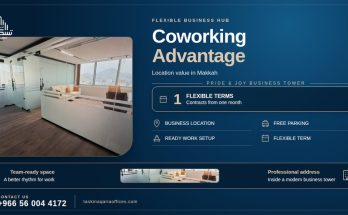
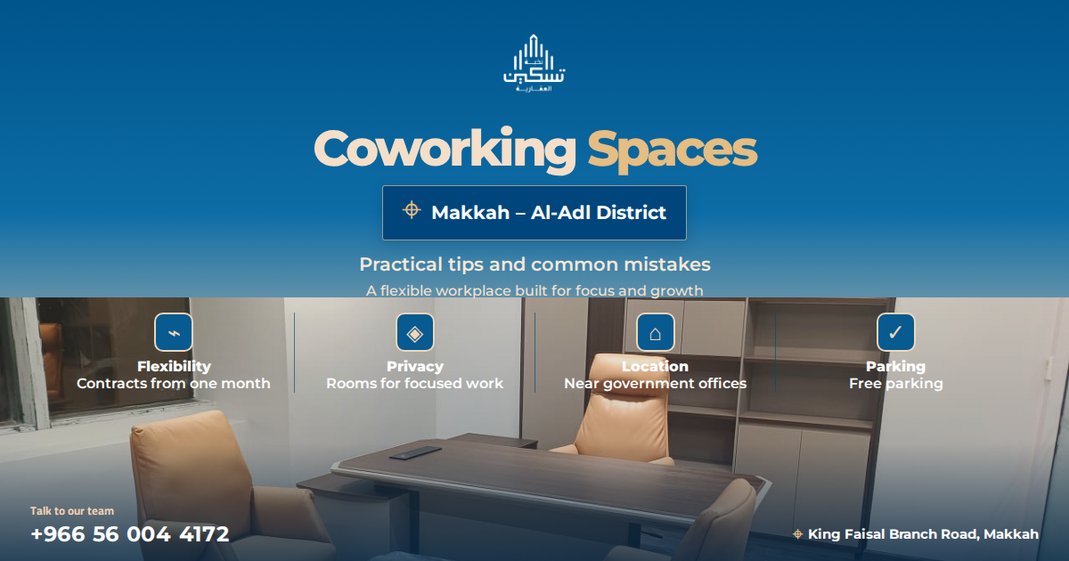
At Pride & Joy Business Tower in Al-Adl district, Makkah, businesses can consider offices in varied sizes and flexible contracts starting from one month. The tower also offers free parking and views toward the Clock Tower and Ghar Hira from relevant locations. It is positioned near government offices on King Faisal branch road by Jabal Al-Nour.
When speaking with Taskin Aqaria, explain the team size, meeting pattern, and privacy requirements. You can also ask about Pride & Joy Business Tower as a flexible office setting in Makkah. A direct conversation makes it easier to compare the real need with a suitable option.
These characteristics may suit a freelancer who needs a professional address, a startup testing its next stage, or a remote team that needs a dependable meeting base. The right fit still depends on the business. A site visit and a careful contract review remain essential parts of a responsible decision.
The wider business environment is also changing through national economic development and service expansion. The official Saudi Vision 2030 provides useful context for that transformation. Business owners can then connect the broad direction with immediate workplace needs.
Final Checklist: Choose a Workplace That Removes Friction
The strongest coworking decision combines access, clear terms, practical readiness, and sufficient privacy. Do not let a polished image or a vague promise make the choice for you. Visit, ask, compare, and document the answers.
Flexibility becomes valuable when it supports a defined plan. Set out what the team needs now, identify what may change, and confirm how the agreement handles that change. This approach keeps the workspace aligned with the business instead of making the business adapt unnecessarily.
If you are comparing a shared workplace or an administrative office in Makkah, start with a direct conversation about your activity and team needs. Contact Taskin Aqaria today to explore a workspace that fits your business in Makkah.