Benefits of Coworking Spaces: Location Value and Return
For established companies, a flexible workspace has value when it improves access, coordination, and business presence—not simply when it supplies desks.
Enterprise leaders assessing flexible capacity should treat the benefits of coworking spaces as an operating question. The right setting can support project teams, visiting managers, and client meetings without forcing a permanent expansion decision. Therefore, the best evaluation begins with the work that must happen there and the people who need reliable access to it.
Location is central to that decision. A workspace can be well equipped yet create friction if employees lose time reaching it or visitors struggle to find it. Conversely, a professionally managed, accessible site can make meetings simpler to arrange and easier to attend. For companies with an established brand, that day-to-day consistency matters as much as the physical setting.
Benefits of Coworking Spaces Start with Location Value
Flexible work space is sometimes evaluated as though it were separate from the company’s wider footprint. In practice, its location changes the experience of employees, suppliers, partners, and customers. A convenient address can reduce unnecessary movement between appointments. It can also give regional or visiting teams a recognizable point for focused work and planned discussions.
In Makkah, businesses often coordinate with clients and institutions across a busy urban environment. Choosing a professional work environment Makkah can help make that coordination more predictable. The goal is not to claim that one address solves every business challenge. Instead, it is to select a location that removes avoidable barriers from routine interactions.
The Al-Adl district, near Jabal Al-Nour and King Faisal branch road, places a business workspace within an active Makkah setting. Proximity to government offices is relevant for companies that need practical access during the working week. In addition, the surrounding city context gives teams a location that feels connected to their market rather than isolated from it.
Access Supports Business Flow
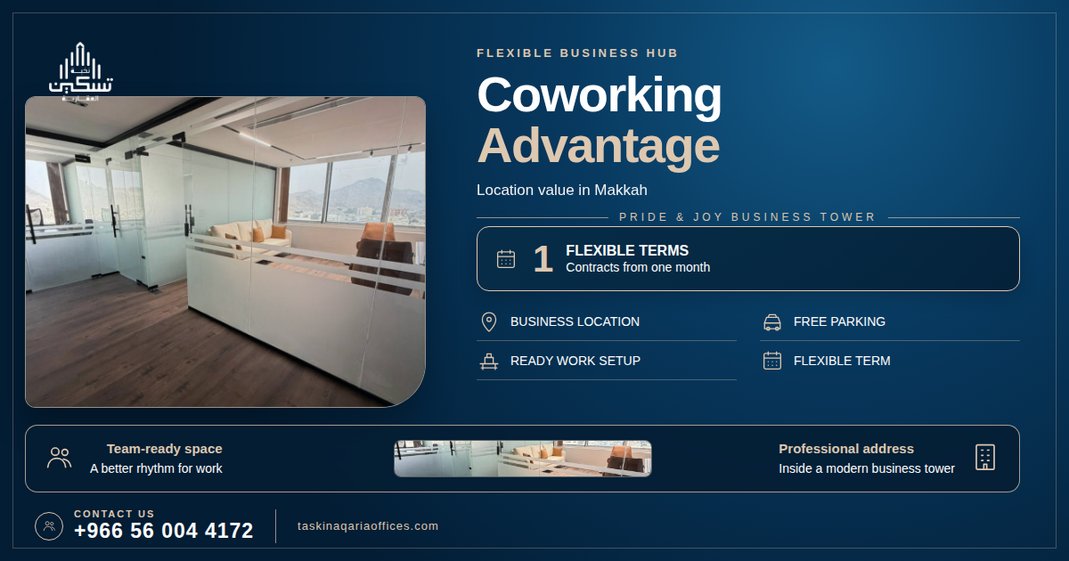
Access should be reviewed from more than one viewpoint. Employees need a straightforward commute and practical parking. Clients need clear directions, a credible arrival experience, and a meeting space that respects their time. Free parking is therefore more than a convenience; it can reduce a small but repeated source of meeting friction.
Decision-makers should also consider the rhythm of their teams. A field team may need an easy place to regroup. A senior manager may need a prepared location for interviews or vendor discussions. By matching the site to the business journey of its users, a company can turn a flexible workspace into a dependable operational touchpoint.
Return on Investment Is Measured in Use, Not Just Rent
A sound return does not come from a low headline figure alone. It comes from how fully the company can use the space, how quickly teams can begin work, and how much operational effort is avoided. That is why a conversation about coworking membership prices Makkah should include contract terms, access, services, and the real pattern of attendance.
For a company launching a temporary initiative, a ready environment can protect management attention. Teams do not need to spend the same time coordinating furniture, maintenance arrangements, or a separate office setup. Moreover, a flexible contract that starts from one month gives the company room to assess actual demand before widening its footprint.
The less visible return is often organizational. If a distributed team has no agreed place to meet, collaboration moves into fragmented calls and improvised venues. A shared base can give important work a regular home. As a result, managers can create a clearer cadence for planning, reviews, training, and client-facing activity.
Ready Space Shortens the Distance Between Plan and Action
Businesses frequently need capacity at a specific moment rather than at the end of a lengthy property process. This may happen when a new contract begins, when a specialist team visits Makkah, or when an internal project reaches a critical phase. A flexible workspace can respond to that need with a practical option that does not overstate its role.
However, readiness must be tested. Companies should ask how the space functions during normal work hours, where private conversations can take place, and how meeting arrangements are handled. They should also check the quality of the common areas and the procedures for visitors. A site that works well in a tour but not in a working day will not deliver the intended return.
Benefits of Coworking Spaces for Enterprise Capacity
Large organizations do not always require another wholly dedicated office. They may need flexible capacity for a focused team, an overflow period, or a local presence while a broader decision is made. A coworking space Makkah can serve that role when its use is governed by a clear internal plan.
For example, a company can set fixed collaboration days for a project group while allowing individual work to continue elsewhere. It can use the space as a base for customer appointments, onboarding sessions, or planned workshops. Additionally, it can provide remote employees with a consistent place for meetings without making each person manage a different venue.
Elastic capacity works best when senior leaders define its purpose. Teams should understand what work belongs in the shared environment, which meetings require a private setting, and how bookings are controlled. With those principles in place, the office becomes a structured extension of the company’s operations rather than an informal fallback.
Professional Presence Matters to Established Brands
Companies that have invested in their reputation should consider what a meeting location communicates before the discussion begins. A tidy, accessible workspace with a professional setting can support a calm arrival and a more focused conversation. It does not replace the quality of the company’s service. Yet it can give that service an appropriate physical context.
This is especially useful when teams meet new partners, interview candidates, or host customers who need a straightforward place to visit. A central point can reduce ambiguity in invitations and make calendar planning easier. Furthermore, the ability to receive people in a well-managed environment supports the discipline expected of an established enterprise.
Location value also has a human side. Employees who can reach a workspace and settle into a purposeful setting are more able to focus on the work at hand. Managers should therefore compare the full arrival-to-departure experience. That includes access, parking, wayfinding, seating, meeting needs, and the atmosphere of the surrounding building.
Coworking vs Private Office Is a Governance Decision
The choice between coworking vs private office should not be driven by fashion. It should follow the sensitivity of the work, the team’s attendance pattern, and the level of concentration required. Coworking is often suitable for collaboration, short-term capacity, and flexible team presence. A private office may be better for confidential material, sustained quiet work, or a team that needs dedicated control of its space.
Many enterprises benefit from using both options deliberately. A shared environment can handle open collaboration and scheduled client-facing work. A private office can support sensitive discussions or uninterrupted delivery. Therefore, the practical question is how each setting fits into a single operating model, not which one is universally superior.
Before deciding, leaders can map the work by type. Identify which activities need client access, which involve confidential information, and which benefit from spontaneous team exchange. Then compare those needs with the workspace rules and physical layout. This approach keeps the decision connected to business reality.
Putting Flexible Work Into Practice in Makkah
Taskin Aqaria provides office solutions designed around practical business use. At Pride & Joy Business Tower, companies can assess flexible work arrangements within a modern administrative tower in Makkah. The location, varied office sizes, and contracts starting from one month give decision-makers several factors to review against their needs.
For enterprise teams, the process should start with a site visit and a concise use case. Bring the people who manage operations, client meetings, and employee needs. Test the access route, observe the working environment, and discuss likely attendance patterns. This produces a more useful decision than selecting a space from a description alone.
Companies can also use the Taskin Aqaria Blog to explore further workplace considerations. For broader business context, the priorities in Saudi Vision 2030 show the continuing importance of service quality, productive employment, and diversified economic activity. A workspace decision should remain grounded in the company’s immediate operational needs while recognizing that wider direction.
A Review Framework for Corporate Decision-Makers
Start with the company’s purpose for the space. Is the aim to host clients, bring a temporary team together, provide a regional base, or support employees who work remotely? Next, list the activities that must be carried out comfortably. This helps distinguish essential requirements from attractive but less important features.
Then review the contract and operating arrangements in detail. Confirm the intended duration, access expectations, visitor procedures, and support available to the team. In addition, establish one internal owner who can collect feedback and make adjustments. A flexible arrangement achieves more when somebody is accountable for how it is used.
Finally, review performance after the team begins work. Look for practical signals such as meeting reliability, employee ease of access, client experience, and whether the space supports the intended work. These observations are more useful than assumptions. They allow the company to keep, expand, modify, or end an arrangement on the basis of real use.
The Case for Location-Aware Coworking
The strongest case for coworking is not that it suits every company or every task. It is that, in the right location and with the right operating rules, it can give an enterprise flexible capacity with a credible business setting. Its value grows when access is easy, the environment is ready, and the company has a clear reason for using it.
Reserve your seat now in the coworking spaces at Pride & Joy Business Tower in Makkah — contact Taskin Aqaria through the official website.