Coworking Space Makkah: Smarter Choices for Startups
For a startup, a workplace is a working decision before it is a real-estate decision. The right setting can make client meetings easier, give a small team a dependable routine, and avoid committing too much capital before the business has settled into its operating rhythm. The wrong setting can add friction every day—through difficult access, unclear services, or a layout that does not match how the team actually works.
A coworking space Makkah can offer a practical middle ground between working entirely from home and moving immediately into a fully dedicated office. Still, “coworking” is not a single product. Startups should compare spaces through the lens of their people, meetings, work patterns, and next stage of growth rather than choosing on appearance alone.
Frame the Decision Around the Next Operating Quarter
Start with a realistic view of the next few months. Will the founders be in the same place most days? Is the business hiring, interviewing, or meeting suppliers and clients? Does the team need quiet time for product work, or frequent short collaboration sessions? A workplace that fits the current quarter can be more valuable than a large office chosen for an imagined future.
Write down a simple usage profile before visiting any location: who will attend, how regularly they will come, what they will do there, and what type of visitor the business expects. This profile gives each tour a purpose. It also prevents a startup from paying for features it will rarely use while overlooking the few details that have an immediate effect on productivity.
Compare Flexibility, Not Just the Initial Cost
Early-stage teams need room to adapt. A flexible arrangement can be especially useful when headcount, meeting frequency, or customer-facing activity is still changing. When evaluating an affordable coworking space in Makkah, ask how the agreement responds to those changes. Can access be adjusted? What are the options if the team needs a different format? Which services are standard, and which are booked separately?
Affordability is not simply a lower headline figure. It means the business understands what it is receiving, can estimate its actual use, and is not locked into a space that is either too large or too limited. A transparent discussion about terms, access, and add-ons matters more than an attractive offer described in broad language.
Build a Like-for-Like Comparison
Access and Daily Reliability
Ask how members enter the building, how reception works, and whether the working hours match the team’s habits. Reliable access is easy to underestimate until a client is waiting or an important call is about to begin. Also consider the route from parking or drop-off to the workspace, especially if visitors will arrive independently.
Privacy and Focus
Startups often need both open collaboration and occasional discretion. Sales calls, candidate interviews, investor discussions, and internal reviews should not be forced into a noisy shared setting. Review the availability of meeting rooms, quiet zones, and the rules for booking them. A well-designed flexible workspace should let a team shift its mode of work without making privacy difficult.
Included Services and Budget Visibility
Searches for coworking membership prices Makkah can return very different offers because the included services vary. Rather than comparing a single figure, request a clear service list: internet, reception, shared amenities, meeting-room use, parking, support, and access hours. The goal is not to buy every possible amenity; it is to know exactly which operational basics the startup can rely on.
Location as a Working Advantage
A central location is valuable when it reduces the effort needed to meet customers, partners, and suppliers. It can also make the company’s address easier to explain and its arrival experience more professional. Test the journey at a sensible time of day. Look at signage, parking, surrounding services, and the general ease of reaching the building. These details shape how both the team and visitors experience the business.
Coworking Versus a Private Office: Use Cases Matter
The question of coworking vs private office should be answered with operating needs, not status. Coworking can suit a new venture that needs a professional base, a flexible attendance model, and access to shared facilities without setting up an office from scratch. A private office may be the better match when a team has a stable daily presence, handles sensitive conversations often, or requires uninterrupted concentration for long blocks of time.
There is also a useful staged approach. A company may start with shared work arrangements, observe its routine, and then move to a dedicated office when the team has consistent requirements. Choosing a location that can support more than one format can make that transition simpler and avoid the disruption of relocating just as the company is gaining momentum.
Think Beyond the Founder’s Desk
Founders can often work in almost any setting, but a startup’s workplace must eventually support more than the founder. Consider new hires, visiting clients, advisors, and specialists. Will they understand where to go? Can they meet comfortably? Is there space to present work with the right level of privacy? These questions turn the workplace from an individual preference into part of the company’s operating system.
The same reasoning applies to independent professionals. A coworking space for freelancers can be useful not only for a desk but also for meeting clients in a clear, professional environment. For startup teams, that benefit scales into a repeatable setting for collaborations, workshops, and regular customer conversations.
What to Review During a Site Visit
- Visit at a time that resembles your expected workday so you can judge the real atmosphere.
- Walk the path a visitor would take from arrival to reception and meeting space.
- Ask how meeting rooms, shared areas, and parking are managed in practice.
- Check the condition of the workspace, the quality of light, and the availability of suitable places for focused work.
- Request a written outline of the services, use conditions, and flexibility available to the team.
- Picture a client meeting, a hiring interview, and a normal workday; the setting should support all three at the level your business needs.
A short, thoughtful visit can reveal more than a list of amenities. It turns the selection process into an assessment of the workday your team will actually have.
A Makkah Option to Include in Your Shortlist
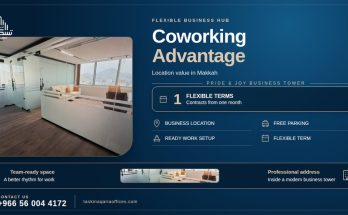
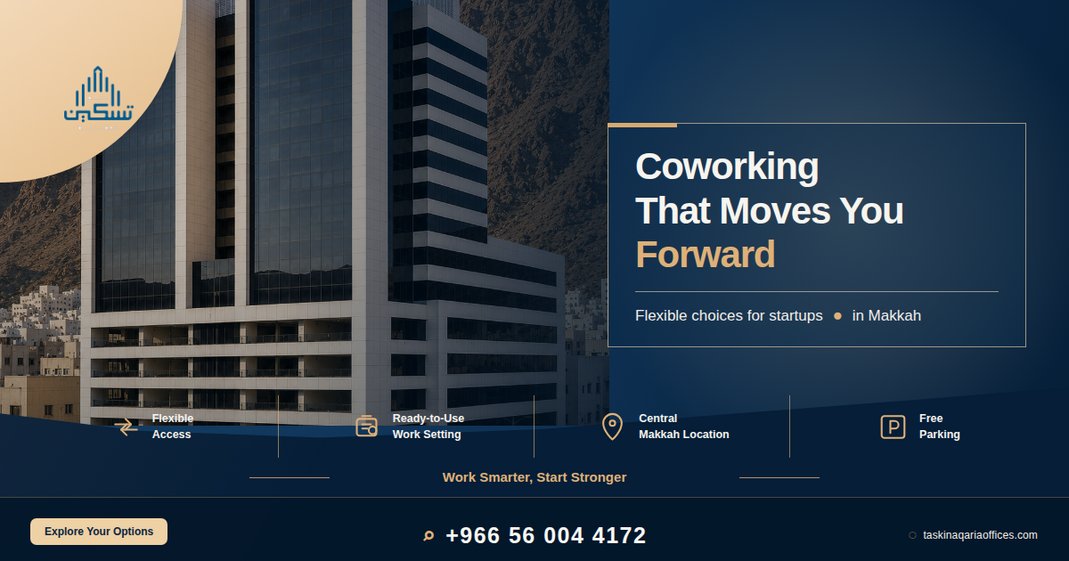
Taskin Aqaria develops, manages, and operates real-estate projects with business use in mind. Its Pride & Joy Business Tower is located in Al-Adl district in Makkah, on King Faisal branch road near Jabal Al-Nour. The tower offers administrative units in varied configurations, free parking, and flexible lease contracts starting from one month—details worth discussing when a young company is deciding how much commitment it needs.
For a startup, the tower’s location near government offices and its accessible business setting can be assessed alongside the day-to-day factors already outlined: how the team will arrive, how clients will be received, and whether the arrangement can evolve with the business. During a conversation with Taskin Aqaria, be specific about work patterns rather than asking only for a generic quotation. Explain the expected team size, meeting needs, and timing so that the available options can be considered properly.
It is also useful to review the different administrative possibilities at Pride & Joy Business Tower with a future move in mind. A flexible initial arrangement is most valuable when there is a clear next option if the team changes shape, takes on more client meetings, or needs a more dedicated environment.
Run a Small, Honest Workplace Test
Where possible, treat the decision as an operational test rather than a permanent declaration. Set a short review point and ask the team direct questions: Did the setting improve punctuality? Were meetings easier to host? Did people have enough quiet time? Was reaching the location straightforward? The answers can be qualitative; the purpose is to understand whether the workplace supports the business’s actual rhythm.
Be equally honest about what is not working. If the team needs more privacy, more predictable access, or a different layout, raise that early. A flexible workspace is valuable precisely because it should help a startup refine the way it works rather than force it into an unsuitable pattern.
Avoid the Common Shortcuts
Do not choose a space solely because it is closest to one member of the team. Do not assume that a meeting room is always available, or that a listed service is included in every arrangement. Do not treat visual design as proof of operational quality. And do not compare offers without first defining the use case; a lower-cost choice that does not support client meetings or focused work is not automatically better value.
For more practical perspectives on business spaces and leasing considerations, visit the Taskin Aqaria Blog. Use such material to inform your questions, then make the final decision through a clear brief and an in-person assessment of the workspace.